

NitiSaar Consulting

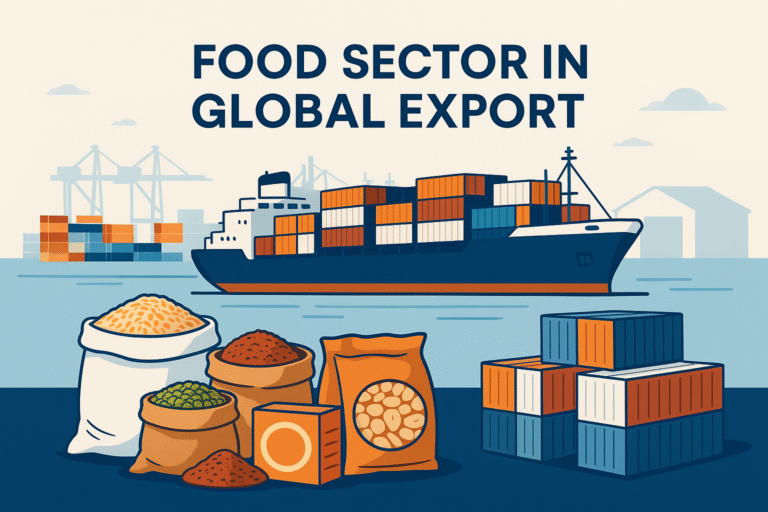
Food Sector in Global Export: India’s Role and Global Trends

Published On : 10 November 2025

The global food industry has become one of the fastest-growing sectors in international trade. From grains and spices to processed snacks and beverages, the world’s appetite for diverse foods is driving new opportunities for exporters.

In this article, we explore how the global food trade is evolving, India’s export performance, and what businesses must do to stay competitive in the global market

Global Food Trade Overview

The international food trade has seen extraordinary growth. In 2023, agricultural and food exports were worth nearly US $1.9 trillion, accounting for about 8% of total merchandise trade.

With rising prices of commodities like cocoa, coffee, tea, and edible oils, the global food import bill is expected to cross US $2 trillion in 2024.

Compared to 2000—when total food trade was around US $400 billion—today’s figures reflect globalization, urbanization, population growth, and changing eating habits.

However, growth remains uneven: while packaged foods and beverages are rebounding strongly, some markets in Asia and Europe have slowed down due to regional factors.

Top Food Exporting and Importing Regions

Major Exporters
  • North & South America: USA, Brazil
  • Europe: Netherlands, Germany, France
  • Asia: India, Vietnam, Thailand
Major Importers
  • China (≈ US $140 B food imports)
  • United States
  • European Union (Germany, Netherlands)
  • Japan & Middle East countries

High-income nations account for nearly two-thirds of global food imports, mainly demanding premium, high-quality, and processed foods.

India’s Rising Position in Global Food Exports

India is now among the top 10 food exporters in the world. In FY 2023–24, India’s agricultural and processed food exports reached around US $50 billion, with a small dip from the previous year due to export curbs on staples.

Key Indian Food Exports
  • Rice (Basmati & Non-Basmati)
  • Spices (Turmeric, Pepper, Cumin)
  • Tea & Coffee
  • Fruits & Vegetables (Mango, Banana)
  • Meat, Dairy, Poultry Products
  • Edible Oils & Pulses

Basmati rice exports alone touched US $5.2 billion in 2023, a 22% increase.

To reduce dependence on staples, the government has identified 20 high-potential export items, including bananas, cashews, buffalo meat, and alcoholic beverages.

As a result, fruits and vegetables exports grew by 14%, and meat, dairy, and poultry exports rose by 12.4% in 2023–24.

Yet, India’s share in the global processed food market is only 2.2%, showing a massive growth opportunity for the coming decade.

Major Product Categories in Global Food Trade

The global food export industry covers a wide range of products, including:

  • Cereals & Grains: Wheat, rice, maize
  • Edible Oils: Soybean, palm, rapeseed
  • Sugar & Sweeteners
  • Meat & Dairy Products
  • Seafood & Frozen Foods
  • Processed Foods: Snacks, beverages, confectionery

Spices, herbs, and natural products remain vital exports for Asian countries. Meanwhile, organic foods, herbal products, and nutraceuticals are witnessing strong demand as consumers become more health-conscious.

Exporters who focus on organic and certified premium foods can unlock high-value global markets.

Challenges for Global Food Exporters

Despite growth, exporters face several key challenges:

  1. Geopolitical tensions and trade disruptions (like conflicts affecting shipping routes).
  2. Price fluctuations in agricultural commodities.
  3. Government export restrictions on essential goods such as rice or wheat.
  4. Strict import regulations in different markets — for instance, the EU’s pesticide residue rules or the US FDA’s food safety laws.
  5. Infrastructure gaps, such as limited cold chains, testing labs, and logistics networks.

Addressing these issues is essential to stay competitive in the world food market.

Export Readiness and Food Safety Compliance

To grow in international trade, quality and compliance are non-negotiable.

For Indian Exporters:
  • Obtain an FSSAI Central License
  • Implement a Food Safety Management System (FSMS) based on HACCP, GMP, and GHP principles
  • Follow international frameworks like ISO 22000, FSSC 22000, or BRCGS

Meeting these standards builds global buyer confidence and helps exporters reach top retail chains abroad.

Why Certification Matters

Certified food exporters:

  • Build trust and credibility
  • Gain access to premium global markets
  • Ensure traceability and product safety
  • Stay ahead of regulatory changes

To stay export-ready, businesses should conduct regular audits, lab testing, and continuous training for food handlers.

Conclusion

The global food export market continues to grow, offering exciting opportunities for exporters who maintain quality, safety, and innovation.

For India, the road ahead is promising — with strong government support, world-class agricultural potential, and increasing demand for Indian products worldwide.

By combining compliance, certification, and smart marketing, Indian exporters can strengthen their global presence and contribute significantly to the country’s export growth.

Related Blogs

Scroll to Top