
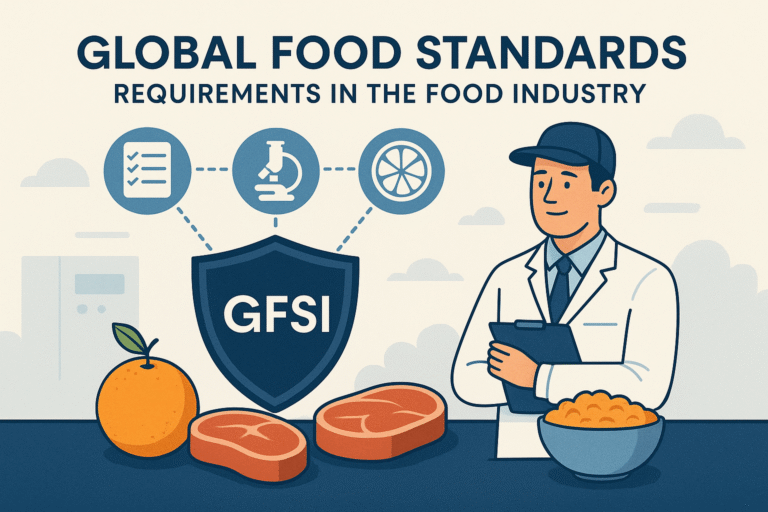

Global Food Standard Requirements for Export Success
Published On : 10 November 2025
In today’s competitive world, exporting food products successfully requires more than just good taste — it requires trust, quality, and compliance.
To sell in global markets, food businesses must meet internationally recognized food safety and quality standards. These include Codex Alimentarius, ISO/FSSC 22000, BRCGS, and country-specific rules like US FDA and EU Food Laws.
Understanding and applying these standards not only ensures product safety but also opens doors to new export markets and global buyers.
1. Codex Alimentarius – The Global Reference for Food Safety
The Codex Alimentarius is a joint program of the FAO and WHO, and serves as the international foundation for food safety standards.
It provides scientific guidelines on:
- Food hygiene and sanitation
- Contaminant levels (like pesticide residues and veterinary drug limits)
- Food additives and labeling rules
Although Codex standards are voluntary, most countries base their national food laws on them. Codex also supports fair trade and helps resolve disputes between countries by setting globally accepted safety benchmarks.
Why it matters:
Aligning your products with Codex standards means meeting the minimum global safety expectations, making exports easier and more reliable.
2. ISO 22000 and FSSC 22000 – Building Strong Food Safety Systems
ISO 22000:2018
This international standard defines the framework for a Food Safety Management System (FSMS) that any organization in the food chain can use — from farms to packaging and distribution.
It combines HACCP principles (Hazard Analysis and Critical Control Points) with management system practices similar to ISO 9001.
ISO 22000 certification shows that your organization follows systematic food safety controls, ensuring that food is safe at every step.
FSSC 22000
The Food Safety System Certification (FSSC 22000) builds on ISO 22000 by adding sector-specific programs (like ISO/TS 22002) and is officially recognized by the Global Food Safety Initiative (GFSI).
FSSC 22000 certification signals to buyers that your facility follows a globally benchmarked FSMS.
For small and medium businesses (SMEs), the FSSC Development Program offers a step-by-step approach to reach full certification. It’s especially useful for companies entering export markets for the first time.
Why it matters:
Having ISO 22000 or FSSC 22000 certification helps exporters gain buyer confidence, meet international regulations, and access top retailers around the world.
3. BRCGS – The Global Standard for Food Safety
The BRCGS Global Standard for Food Safety (developed by the British Retail Consortium) is one of the most widely accepted certifications worldwide.
It covers all key aspects of food manufacturing, including:
- Product quality and legality
- Hygiene and sanitation
- Traceability and food defense
- Supplier approval and internal audits
Over 22,000 sites across 130+ countries follow the BRCGS standard. It’s often mandatory for suppliers to major UK and European retailers.
Why it matters:
BRCGS certification can open doors to supermarkets and global retail chains, proving your company’s commitment to safe and high-quality food production.
4. US and EU Food Safety Regulations
Alongside global standards, exporters must comply with national laws in target markets.
United States
The US Food and Drug Administration (FDA) enforces the Food Safety Modernization Act (FSMA), which requires:
- Preventive food safety controls
- Compliance with Current Good Manufacturing Practices (CGMPs)
- Strict allergen and sanitation controls
Exporters to the US often need to register their facilities and may require a Foreign Supplier Verification Program (FSVP) importer code.
European Union
The EU General Food Law (Regulation 178/2002) ensures food traceability and consumer safety.
Regulations 852/2004 and 853/2004 set hygiene standards and rules for products of animal origin.
Labeling requirements (EU 1169/2011) must also be followed carefully.
Why it matters:
Understanding and meeting US/EU regulations helps exporters prevent border rejections, recalls, and ensures smooth customs clearance.
5. Other Important Standards and Certifications
Apart from Codex, ISO, and BRCGS, exporters can benefit from adopting other recognized systems such as:
- SQF (Safe Quality Food) and IFS (International Featured Standards) — both GFSI-benchmarked schemes
- GAP (Good Agricultural Practices) and GHP (Good Hygiene Practices) for farms and facilities
- Organic, Halal, or Kosher certifications for niche and premium markets
Why it matters:
Holding multiple certifications boosts market access, enhances brand reputation, and meets diverse buyer requirements.
6. How to Align Your Operations with Global Standards
For small and medium exporters, alignment starts with:
- Implementing a Food Safety Management System based on Codex/HACCP principles
- Getting certified to ISO 22000 or FSSC 22000
- Conducting hazard analysis and developing clear Standard Operating Procedures (SOPs)
- Training employees on hygiene and traceability
- Running mock recalls and internal audits regularly
Using gap analysis tools and internal audits helps identify weaknesses before certification.
Once ready, companies can approach accredited certification bodies for formal audits and certification.
7. Benefits of Global Food Standard Compliance
Adopting and maintaining global standards delivers significant business advantages:
• Builds trust and transparency with buyers
• Reduces trade barriers and speeds up customs clearance
• Prevents rejections or detentions at import ports
• Enhances brand image and consumer confidence
• Enables access to premium and international markets
Simply put, certification to global standards like ISO 22000, FSSC 22000, or BRCGS gives exporters a competitive edge in the world food trade.
Conclusion
Understanding and implementing international food standards is no longer optional — it’s essential for anyone aiming to succeed in global exports.
For Indian and international SMEs, adopting frameworks like Codex, ISO 22000, FSSC 22000, and BRCGS can transform operations, ensuring safety, quality, and trust at every stage.
By aligning with these standards, exporters can unlock global market access, build a strong brand reputation, and stay ahead in the fast-evolving food export industry.